
Building a Business That Runs Without You
By Prime Advisory, 25 September 2026
Think about what happens to your business the week you are not in it. For many owners, the honest answer is that it slows down, and if the break runs long enough, it stops. That matters because it is also a big factor in what the business is worth.
In our last post, we explained how a business is valued. Your profit, also known as EBIT, is multiplied by a number called a multiple (also known as the capitalisation rate). The profit is the part most owners work on. The multiple is the part most owners never think about, and it moves the value just as hard.
Plenty of things move the multiple; the single biggest one, and the part this piece is about, is whether the business can run without you in it.
Buyers pay for a business, not a job
If the business only works when you are in it, then what you own is closer to a well-paid job with staff than a business. You feel it every time you try to take a week off, and the place starts calling. A buyer feels it from the other side. If you are the business, then the day you step out, the value steps out with you, so they discount heavily for the risk. A business that runs without the owner every day is worth more, because the earnings belong to the business, not one person. That holds whether or not you ever sell. The buyer is simply the one who puts a price on it.
My own business is the example I know best. Twenty years ago I started with a secretary, and that was it. I handled the sales, admin, and work. If I took a holiday, the business stopped, because the business was me.
Today I can take a month off, and it keeps going. Enquiries still come in, and the work still gets done. Sales may dip slightly while I am away, because I still do some of the selling, but the business has its own momentum now. What made the difference over those years was building something that no longer needs me in every part of it, rather than simply working harder.
Why the same business can be worth seven times more
In the last article, we took a business turning over $5 million and showed how its value moves as margins and multiples improve. Read that table from the bottom-left corner up to the top-right, and you are watching a business go from worth about $1 million to worth about $7.5 million, on the same revenue.
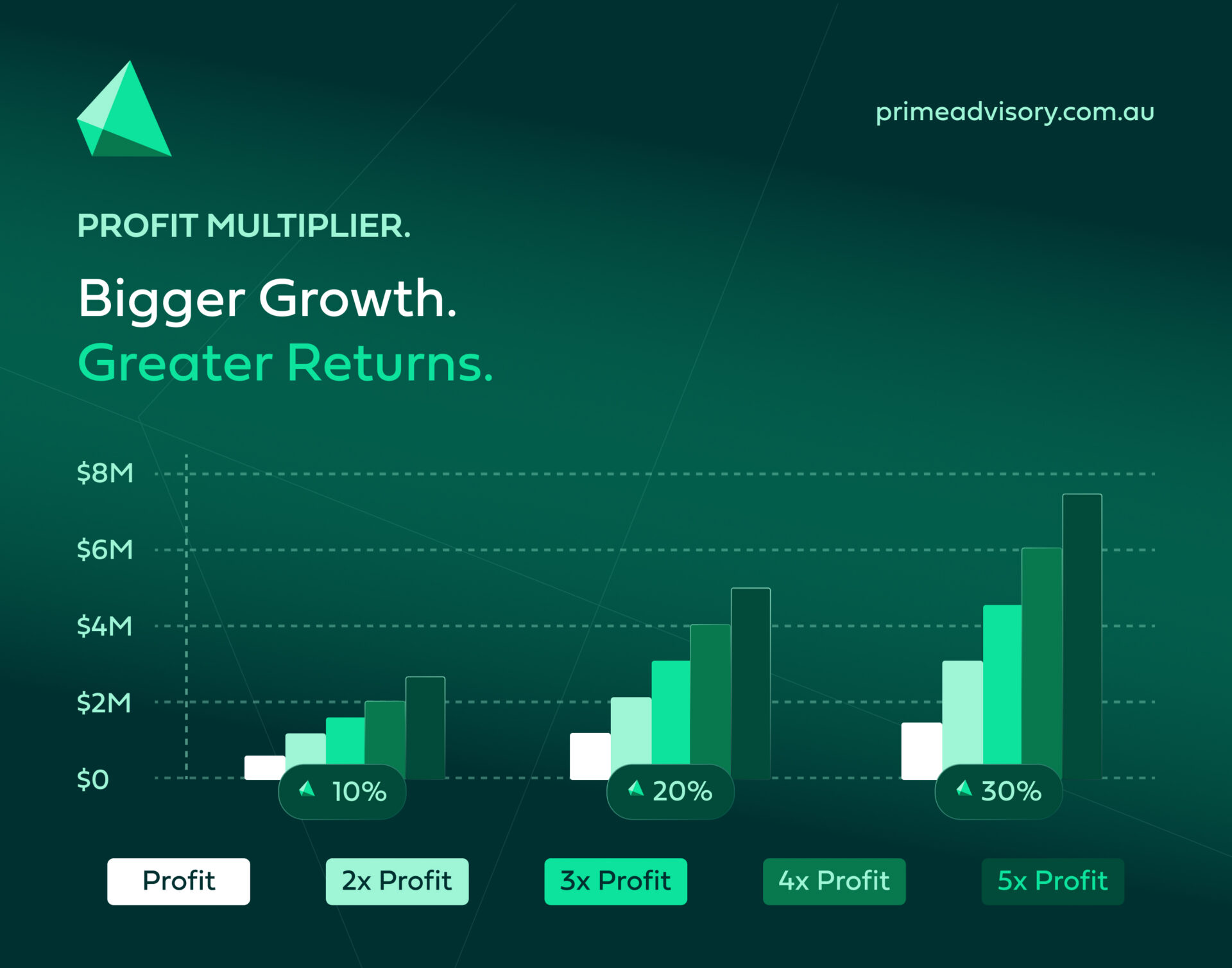
The bottom-left corner is the business at its lowest, a thin margin and a low multiple, with the owner in the middle of everything and the systems in their head. The top-right is the same business earning a healthier margin and, just as important, running without the owner. Two things move between those corners. One is the profit, the margin, which we will come back to another time. The other is the multiple, and that comes down largely to a single question: can the place run without you?
What actually lets a business run without you
Start with an org chart. Not a tidy diagram for the wall, a real one, with every function the business needs written down: marketing to bring the work in, sales to win it, operations to deliver it, and admin to keep it all running. Then put a name against each box.
Do that honestly for a smaller business and you find the same thing nearly every time. Your name is in most of the boxes. That is the whole problem in one picture. It means the business cannot run without you, because in most of the ways that matter, you are the business. You go on holiday, and it comes to a stop.
So the work is to get your name out of the boxes, one by one. That takes three things:
- Job descriptions, so each person knows what they are responsible for.
- KPIs, so each person knows whether they are doing it well, and so do you, without standing over them.
- Documented systems and processes, so the way the work gets done lives on paper rather than in one person’s head. If someone leaves or gets sick, you can put another person in the seat, and the work carries on.
Between them, the team knows what to do, knows whether they are doing it well, and can keep doing it when a person changes. Those three are what let you step back.
This is for a business with a bit of momentum
If you are a sole trader with everything resting on you, start before the org chart. The first move is to bring in some support, so you have a team to build around.
We tend to add the most value once you have somewhere between five and fifteen people working for you. That’s where a lot of owners get stuck. They have moved from doing everything themselves to running a small team, and they cannot quite push through to the next level. Two kinds of businesses, especially. The one on its way up that does not yet know what to look for. And the established business that has plateaued and wants to get back to its former strength. Both know the challenges are real, and both get there faster with a guide alongside them for the next stretch.
Information is not the problem
None of what is above is a secret. Books cover all of it. The E-Myth by Michael Gerber has been telling owners for forty years to work on the business rather than in it. There are courses, coaches and any number of podcasts. Information is not what is missing.
What is missing is focus and accountability. Knowing which two things to do this quarter out of the twenty you could do, and then actually doing them before the quarter is out. That is the part that does not come from a book, and it is the part we do.
In practice, it looks like sitting down each quarter, going through the numbers, and asking the right questions. Can you take a holiday yet? Is the business still driving you mad, and if so, why? You usually have the answers already. The questions pull them out, and they become the two or three projects for the quarter ahead. Then we hold you to them. Those improvements are small on their own, but a run of one per cent gains, quarter after quarter, is how a business moves from the bottom-left of that table up to the top-right. It is rarely one big leap.
A business built on purpose
The point is to build the business deliberately, rather than end up somewhere by accident.
Plenty of owners arrive where they are without quite knowing how they got there. This is the opposite: deciding where the business needs to go, and working toward it on purpose.
Do that, and there are three paybacks, on three different clocks.
- This year, you make more money. A better-run business is more profitable, and it shows up in the next set of accounts.
- Over time, the business is worth more. Every improvement that takes your name out of a box lifts the multiple, and the value climbs with it, whether or not you ever sell.
- Eventually, you get the choice. A business that runs without you is one you can step back from, sell, or keep, on your terms. And when you sit down to work out what retirement looks like, you can put a real number next to the house and the super.
That last payback ties back to knowing the number in the first place. What the business is worth today, what it needs to be worth for the life you are planning, and the work that closes the gap between the two.
Common questions
What does “a business that runs without you” actually mean?
It means the day-to-day keeps working when you are not there, because each function has someone accountable for it, clear targets, and a documented way of doing the work. It does not mean you disappear. It means the business doesn’t depend on you for every decision.
My business is small. Is this even realistic?
It depends on size. A genuine one-person business stops when you stop, and that is fine. Once you have a team of roughly five or more, you have enough to build structure around, and it becomes both realistic and worth doing.
How long does it take?
It is a direction, not a weekend project. Most of the value comes from small, steady improvements quarter after quarter, which is why accountability matters more than information. Owners usually feel the difference well before the business is fully independent.
Do I need to want to sell for this to be worth it?
No. The same work that makes a business sellable also makes it more profitable now and easier to own in the meantime. Whether or not a sale is ever on the table, you get a better business to run today.
Where to start
If nobody has ever drawn your org chart, start there. Write down every function the business needs- marketing, sales, operations and admin- then put a name against each box and count how many of them are yours. That hour alone tells most owners more than they expect, and it costs nothing.
If you would rather talk it through, give us an hour or two. We look at where the business is now, where you want it to get to, and what is keeping you in the middle of it. Most owners come away with a couple of things worth doing, whether or not we ever work together.
Either way, the first step is small. Draw the chart this week, or get in touch and we will draw it with you.