
What’s Your Business Actually Worth? Annual Business Evaluation
By Prime Advisory, 13 July 2026
The asset you don’t measure
You know roughly what your house is worth. You get a super statement every year whether you want one or not. If you hold shares, the number is on a screen.
Then there is your business, which for most of the owners we work with is the biggest asset of the lot, and the one you have never put a figure on.
That is a strange gap, and it matters more than it sounds. Not because you are about to sell. Because everything you are working towards, the point where the mortgage is gone and you can choose whether to keep going, depends on an asset you have never measured.
What drives business value
There is no shortage of material on this online, so we will keep it short.
For an established business with a real customer list and a real team, a buyer looks past revenue and focuses on profit. The value becomes your profit multiplied by a number.
The profit here is your EBIT, earnings before interest and tax. The number is the multiple, and the multiple is where most of the mystery sits. Other methods exist, including discounted cash flow, but they apply to much larger businesses than the ones we are talking about. For most owners reading this, value is profit times a multiple, and that is all you need for this conversation.
Which leaves you two numbers to work on. Your profit is driven by your business’s financials. Your multiple is driven by everything that isn’t financial: governance, systems and processes, and whether the place can run without you. The goal is to improve both.
Why two businesses with the same revenue sell for different amounts
Picture two businesses in the same industry, both turning over $5 million.
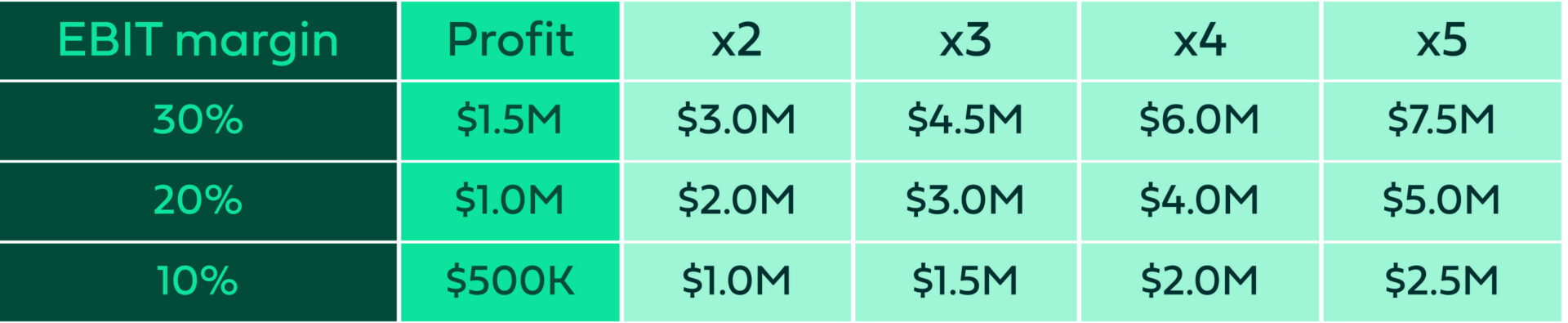
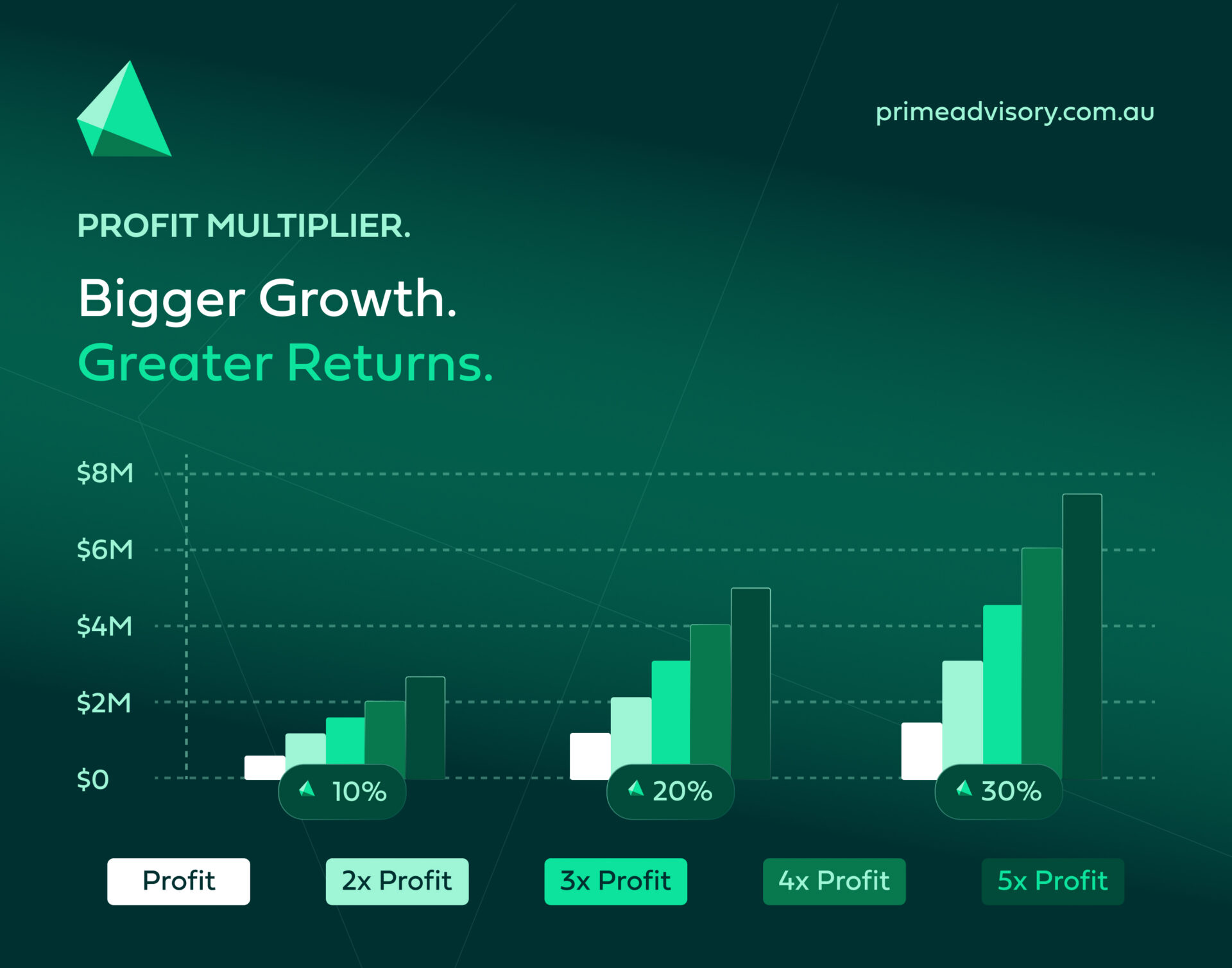
The first runs at a 10 per cent EBIT margin, so it makes $500,000. The second runs at 30 per cent and makes $1.5 million. Same revenue, very different profit, and the margin is the first tell. It measures how efficiently your business is run.
Then the multiple. The first business keeps its systems in the owner’s head and takes a fortnight to produce a set of numbers, so it sits at the bottom of its range, say two times. The second has documented processes, a team that runs the place without the owner, and financials a buyer can read in an afternoon, so it sits near the top, say five times.
Two times $500,000 is $1 million. Five times $1.5 million is $7.5 million. Same revenue, same industry, and one is worth more than seven times the other. We see it constantly.
What actually moves the number
With businesses we work with, here is how that conversation usually starts.
We ask why you went into business. The answer is almost always the same: to be your own boss, to have some financial freedom, to get your time back. Then we ask how that is going, and out comes the list. We cannot find the right staff. We are busy, but there is no profit. I have not had a proper holiday in three years.
Every item on that list is costing you profit, and most of them are costing you the multiple as well.
The goal is to take the list, find the one or two problems sitting underneath it, and turn those into projects. We might identify twenty things worth doing and then ask you to do two this quarter. Twenty projects is a list nobody starts. Two get done.
What that looks like
The useful thing about that grid is that a business can move across it. The two businesses in the comparison could just as easily be one business, before and after.
Picture the owner in the bottom-left corner. Turning over $5 million on a thin margin, the systems in their head, every decision coming back to them, and no proper break in years.
Two or three years of steady work follows. The revenue barely moves. What changes is how your business is run. Pricing corrected, the jobs that never made money stopped, a management layer that runs the place and documented processes so the team can run your business consistently.
Now they are in the top-right corner. Same revenue, a business worth several times what it was, and close to a million more a year in profit whether they ever sell or not. Somewhere in the middle of it they took the family away for a holiday, and your business was fine without them.
Which is why we do it every year
This is the part that matters, and it’s why we raise valuation with clients who have no intention of selling anything.
Say you would like the choice to stop in ten years. You sit down and work out the number you need to retire on. You have a house and super, and there is a gap between what they cover and what you need. Your business is what fills the gap. Today it might be worth $2 million, and the plan needs $5 million. That $3 million is the whole reason to know the number, and to watch it move each year.
So we value your business, put it on your personal balance sheet next to your house and the super, and then do it again every year.
The number itself is not the point. The direction is. Twelve months of effort either moved your position or it kept you busy, and without a number you genuinely cannot tell which. Do that for fifteen years, and you get to make adjustments while there is still time for them to work, instead of finding out at the end.
That is also how your business stops being a thing you own and becomes part of a plan. What it is worth, what it needs to be worth, and what has to change between here and there.
Where to start
If nobody has put a number on your business, that’s where to begin.
Start with a conversation. We will look at where your business is now, where you want it to get to, and what is getting in the way.
You might also find this guide helpful Break-Even and Profit Mastery Guide.
Get in touch, and we will take a look.